
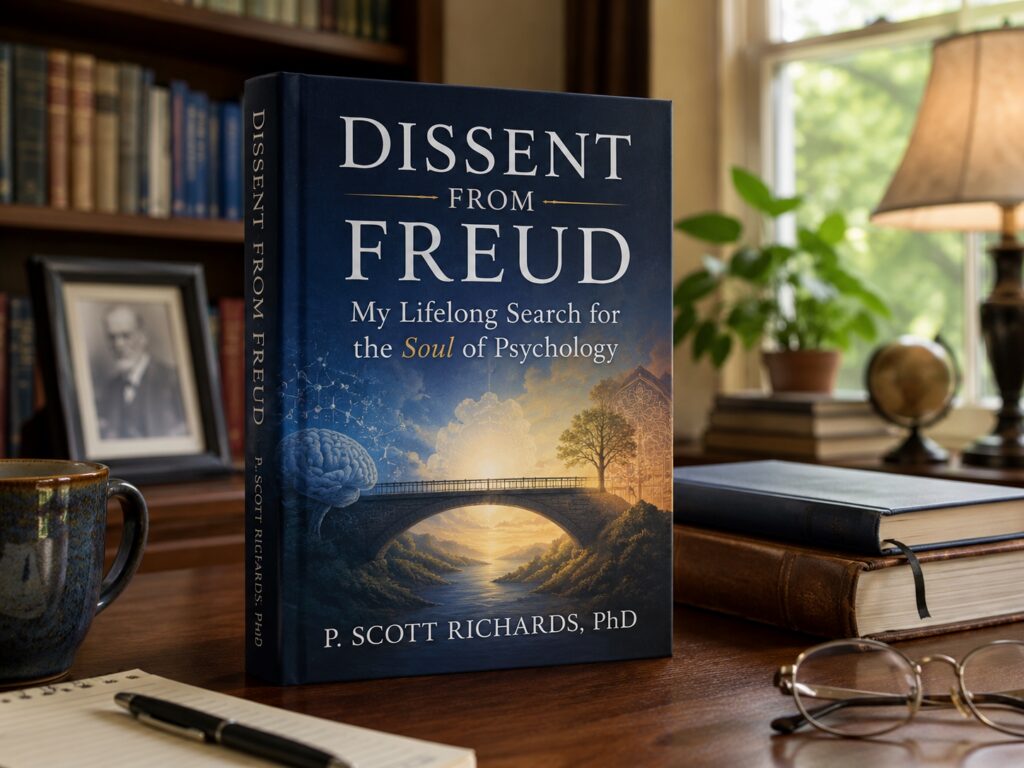
Why do people suffer? Can they truly heal? And what if psychology has overlooked one of the most important dimensions of being human?
When Scott Richards was ten years old, his father was hospitalized with severe depression. Overnight, the security of childhood gave way to fear, confusion, and questions that would shape the rest of his life. Why couldn’t doctors make his father well? Why did suffering persist despite faith and love? And what, if anything, gives people hope when life begins to fall apart?
Those childhood questions eventually led Richards to the front lines of one of the most significant—and controversial—movements in modern psychology. Inspired by psychologist Allen Bergin’s courageous challenge to Sigmund Freud’s conviction that religion is psychologically unhealthy, Richards devoted his career to exploring whether spirituality might be an essential part of emotional healing rather than an obstacle to it.
Told through a beautifully braided narrative that interweaves an intimate family story with an extraordinary professional journey, Dissent from Freud follows Richards from small-town Alberta to graduate school, missionary service, marriage, heartbreaking personal losses, fierce academic battles, groundbreaking scientific research, and ultimately leadership in an international effort to bring spirituality back into mainstream psychology. Along the way, he encounters profound spiritual experiences, institutional betrayal, unexpected triumphs, and a deeper understanding of the mysterious ways suffering can shape a life.
At once deeply personal and intellectually compelling, Dissent from Freud is more than the story of one psychologist’s career. It is the story of one son’s search to understand his father’s suffering—and how that search ultimately helped change the conversation about faith, healing, and the human soul. It is an inspiring memoir about resilience, love, purpose, and the enduring hope that science and spirituality can work together to illuminate the deepest questions of what it means to be fully human.
Chapter 1
Winter 1966—High River, Alberta
I’m ten years old when I find out my father is mentally ill. My mother sits on the edge of my bed. The hallway light behind her casts a soft glow around her shoulders, but her face is shadowed. She looks tired—more tired than usual—and there is something in her eyes I don’t recognize.
I pull the quilt up to my chin and watch her. Outside, the February storm blows against the house. Snow scrapes against the windows. A loose drainpipe bangs against the siding with a hollow metallic clang. The furnace rumbles to life in the basement, and the whole house seems to shudder in the cold.
“Why doesn’t Dad ever come to my hockey games?” I ask. I try to sound casual, but my throat tightens.
Mom smooths the quilt with her hand. She doesn’t answer right away. “The doctors say your dad has had a nervous breakdown,” she finally says.
A jolt of alarm runs through me. “What’s that?”
She takes a breath, as if choosing her words carefully. “Your dad feels sad most of the time. He’s very tired, and it’s hard for him to think clearly. He doesn’t feel good enough to go to work, or to church, or even to your hockey games.”
She pauses. “It’s a mental illness, not a physical sickness. It’s called depression.”
The words hit me hard, like an opposing player knocking me onto the ice with a vicious body check. “Can’t the doctors help him?”
“They’re trying,” she says quietly. “They’ve given him medicine, but it hasn’t helped very much.”
She caresses my hair. “Next week, your dad is going to the hospital. The doctors are going to try electroshock therapy.”
My eyes widen in alarm. Mom sees the fear on my face and reaches for my hand.
“I know it sounds scary,” she says softly. “But it’s not as bad as it sounds. They’ll put your dad to sleep first. Then they’ll place small electrodes on his head and send a brief electric current to his brain. He won’t feel it, and he won’t remember it.”
“What if it doesn’t help?” I ask.
She hesitates. For a moment, something flickers across her face—uncertainty, maybe even fear—and it unsettles me more than anything she has said. “I don’t know, Scott.”
A cold feeling spreads through my chest, colder than the winter pressing against the house. “He’s got to get better,” I whisper. “He just has to.”
“Yes,” she says softly. “You need a dad.” She leans down and kisses my cheek. “I love you, Scott. I don’t want you to worry.” She turns off the light and quietly closes the door, leaving it slightly open.
I lie there in the dark, listening. The storm has settled hard over our small prairie town. Located about 30 miles south of Calgary, High River is surrounded by fields that stretch for miles beneath the wide Alberta sky. Tonight, the town is a world of white and wind. Snowdrifts pile along the streets and sidewalks. Tall wooden grain elevators stand beside the railroad tracks in the middle of town like silent sentinels, trying to protect the town from the storm. The Highwood River runs along the north edge of town, now hidden beneath a thick crust of ice and snow. Beyond town, the frozen prairie fields fade into darkness.
I stare out my window into the blackness and try to imagine what life will be like if Dad doesn’t get better. I won’t see him standing along the boards at the old hockey rink, stamping his boots against the cold while I chase the puck across the ice. I won’t walk along the Highwood River to go fishing with him when the ice melts in the spring. I won’t sit beside him in our car as he drives west toward the tall peaks and green forests of Kananaskis and Banff. The images slip away like my hopes for the future.
Tears fill my eyes. I turn my face into the pillow to muffle my sobs. The quilt rises and falls with my breathing. I lie awake for a long time, wishing for something I do not yet have words for—some way for my dad to be healed, some way for our family to feel whole again. I don’t know it yet, but this night will follow me for the rest of my life. For now, I know only this: I want my dad to come back.
Chapter 2
Provo, Utah—Fall 1979
I take my seat in a classroom in the old Smith Family Living Center on the Brigham Young University campus a few minutes before nine o’clock. The room smells faintly of chalk dust and polished floors. Rows of wooden desks face the front, where a large chalkboard spans the wall. Sunlight filters through the windows, illuminating tiny motes of dust drifting in the air. Around me, a few students shift in their seats while others chatter quietly. I don’t realize it yet, but I am about to witness a pivotal moment in the history of psychology.
Our instructor, Dr. Bruce Brown, stands near the podium at the front of the room, organizing a few papers. When the wall clock clicks to 9:00 a.m., he clears his throat.
“Good morning, everyone,” he says. “I’m pleased to introduce our guest speaker today—Dr. Allen Bergin.” He gestures toward a man seated near the front.
“Dr. Bergin earned his Ph.D. in clinical psychology from Stanford University. He completed a research postdoctoral fellowship with the renowned Carl Rogers at the University of Wisconsin and, until recently, held a full professorship at Teachers College, Columbia University in New York City. He is internationally respected for his research on psychotherapy treatment outcomes and is one of the editors of the highly acclaimed Handbook of Psychotherapy and Behavior Change.”
Dr. Brown turns and smiles. “The time is now yours, Allen.”
I sit up straighter in my chair. Impressed by the introduction, I quickly pull out my notebook and pen, eager to record what this distinguished psychologist will say.
Dr. Allen Bergin stands at the front of the room. He is a short man in his early forties, neatly dressed in a light-blue suit and a dark-blue tie. His eyes move thoughtfully across the room, as if weighing what he will say, and how it will be received.
“Religion,” he exclaims loudly, “is currently on the fringe of clinical psychology when it should be at the center!”
The words hit me with force, startling me. The classroom goes still. No one moves. No one speaks. I lean forward in my seat. He has my undivided attention.
Dr. Bergin continues. “Secular values have an appropriate place in the mental health professions,” he says, “and I agree with many of those values. But they are often indifferent to God and to the possibility that spirituality can influence behavior and mental health in benevolent ways.”
He reaches down and picks up a small book from the podium. “In his famous work The Future of an Illusion, published in 1927, Freud argued that religious ideas are wishful illusions. He believed civilization would be better off abandoning belief in God and replacing it with reason and science.”
He lowers the book slowly. “Other early leaders in psychology followed a similar path—John Watson, B. F. Skinner, even Carl Rogers. Their theories either ignored religion or cast it in negative terms.” He pauses, letting the reality of that settle. “As a result, for much of the twentieth century, psychology has viewed religion with disinterest, suspicion, or even disdain.”
Then his expression shifts slightly. “But not everyone agreed with Freud. Carl Jung believed that spiritual experience was deeply rooted in human nature. William James took religious experience seriously. Gordon Allport argued that mature religion could foster compassion, integrity, and psychological growth.” He glances around the room. “So, there have always been dissenters in psychology—people who believed that human beings are more than biological machines driven solely by instinct and conditioning.”
He pauses. “But their voices never became the dominant voice in modern psychology.” His tone grows more somber. “For most of the twentieth century, the field was dominated by secular, materialistic explanations of human behavior. Spiritual perspectives were marginalized in the mainstream.”
Something stirs in me as I listen. Until this moment, I had never heard a psychology professor suggest there might be another way to think about psychology—one that makes room for both science and faith.
I am only a few weeks into my junior year of college and my first semester at Brigham Young University, still trying to find my place as a psychology major. Outside, the campus hums with energy—students rushing along wide sidewalks beneath the rising slopes of the Wasatch Mountains, their trees just beginning to show the first hints of red and orange. But inside this classroom, everything has narrowed to Dr. Bergin’s words.
Dr. Bergin steps away from the podium and begins pacing slowly across the front of the classroom, his voice growing more animated. “In my view, correcting this bias requires a broader perspective—one that allows for the possibility that God exists, that human beings are God’s creations, and that God and humanity are connected through spiritual processes.”
Dr. Bergin smiles and lifts a typewritten manuscript in his hand. “After I submitted this manuscript,” Dr. Bergin says, lifting the pages in his hand, “titled Psychotherapy and Religious Values, the journal editor contacted me with the reviewers’ feedback.”
A few students lean forward, peering at the manuscript.
“One reviewer recommended outright rejection—arguing that religion has no place in psychotherapy. Another disagreed with my ideas but felt the article should be published simply because I authored it. And the third supported publication.”
A faint smile crosses his face. “Fortunately for me, the editor—who was my former colleague at Columbia University—decided the article should be published. I guess sometimes who you know is more important than what you know.”
A ripple of quiet laughter moves through the room.
His expression grows more serious. “In this article, I criticize the mainstream psychology profession for its anti-religious bias. I challenge psychologists to be more open-minded about religion—and about the possibility that religious faith and communities can have genuine healing power.”
My heart beats faster. This is what I have been searching for—and what, in quiet moments of contemplation, I have felt drawn toward, though I have not understood how it could become real. Because of my father’s mental illness during my teenage years—and because of my own religious beliefs—I have felt a tension I don’t know how to resolve. I want to study psychology and understand mental illness. I want to help people heal. I also believe that faith matters—that it can sustain, guide, and even transform a life. Until this moment, I have not known how I could pursue such interests.
The room is completely quiet. Dr. Bergin smiles. “Are there any questions?”
A few rows ahead of me, my friend Kevin raises his hand. “Why do you think it’s so important to include ideas about God in psychology?” he asks.
Dr. Bergin nods, as if he has been waiting for someone to ask exactly that. “Good question,” he says. “The very word psychology points us in that direction. It comes from two Greek words—psyche, meaning breath, spirit, or soul, and logia, meaning the study of something. So, at its roots, psychology means the study of the soul.”
He pauses and lets that idea settle over the room before continuing. “In my view, psychology lost part of its soul when Freud and many of the other early leaders of our field pushed God and spiritual realities outside the boundaries of legitimate theory and research. Once that happened, atheistic assumptions became dominant. Determinism, materialism, and relativism took center stage, and psychology gradually became a field preoccupied with pathology, conflict, and dysfunction.”
He glances around the room, his voice calm but firm. “I believe we impoverish psychology when we exclude the spiritual dimension of life. When we make room for God, faith, and moral meaning in our research and clinical work, we begin to recover a fuller understanding of what it means to be human. We bring depth, beauty, and hope back into the field.”
His words excite me. I have never heard anyone speak so openly about psychology’s bias against religion and spirituality, making it so clear that the field has left out a key part of its own subject. The room is completely still. No one is shuffling papers. No one is whispering.
. . . . . . . .